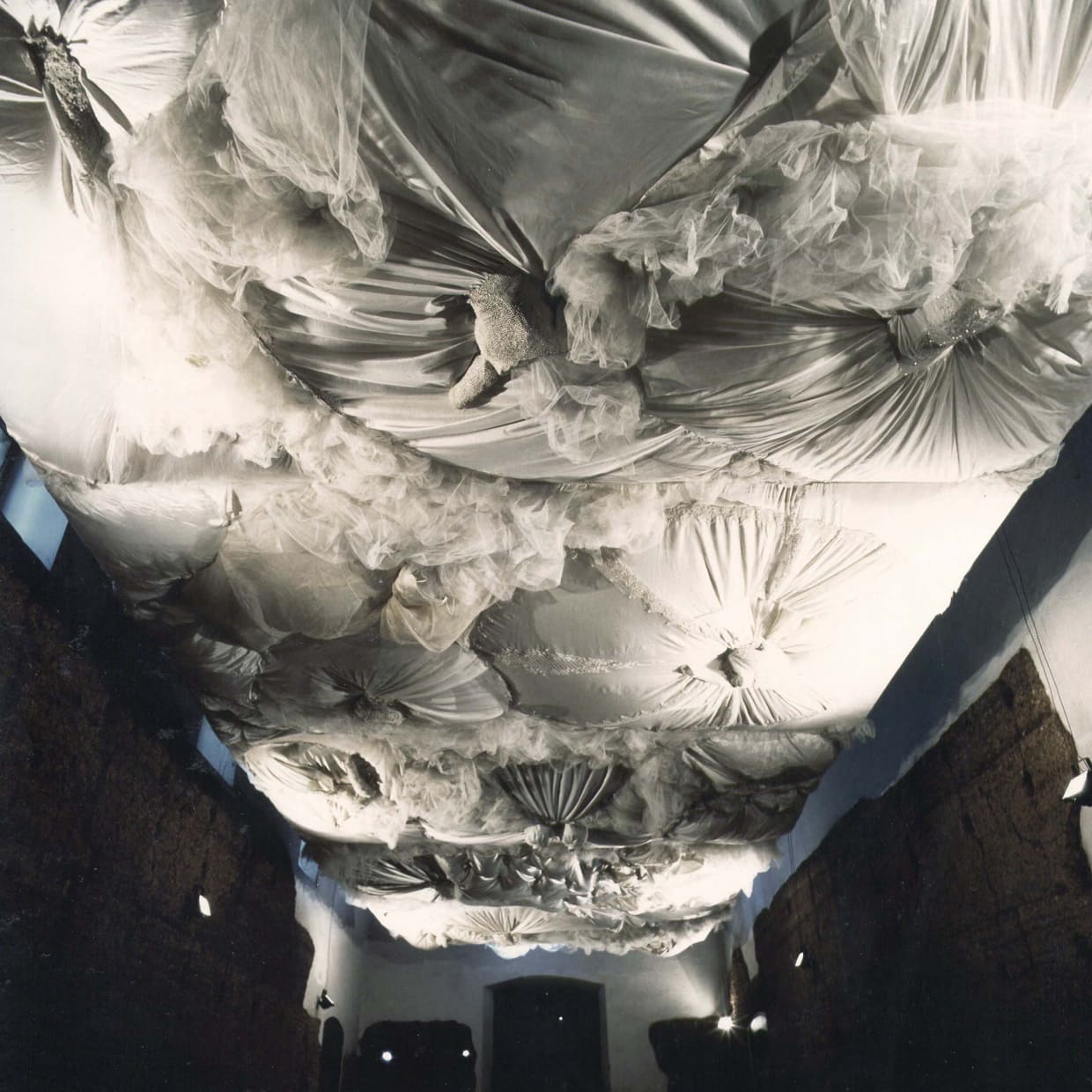
Ao escolher o teto de uma capela como moldura, Beth Moysés cria, inevitavelmente, um metacomentário sobre a tradição da arte ocidental. Particularmente no Renascimento italiano, tetos de capelas se tornaram grandes paradigmas da arte, reunindo obras como o afresco Adoração dos Reis Magos, realizado entre 1304 e 1306 por Giotto na Capela Arena, em Pádua, e, posteriormente, a história de Adão e Eva que Michelangelo executou entre 1508 e 1512 para o teto da Capela Sistina, no Vaticano.
Mas o tom de reverência histórica toma rumo inverso quando a artista substitui a criação pictórica pelo uso direto de materiais extraídos do cotidiano. Num momento de efervescentes discussões conceituais, em que os artistas contemporâneos se envolvem em narrativas que recontam sua própria existência, Moysés costura em seu trabalho tecidos, texturas e ranhuras de uma leitura pessoal da vida. Isso é feito arremessando ao alto uma tapeçaria anônima e coletiva, composta de exemplares do grande mito feminino: o vestido de noiva.
Para rediscutir o mito, ela se apropria diretamente de seu objeto. Forra estrategicamente o teto da capela com um conjunto de 25 vestidos. São vestidos reais, usados nos casamentos de amigas, parentes e da própria artista. São também vestidos-artifícios, comprados, montados, negociados em lojas. Grudados pelas saias, formando um único e longo tecido, os vestidos exibem seus corpetes dependurados, feito lágrimas paradas no ar, recheados apenas com pano. Elevados à altura do teto, cobrindo com o silêncio do branco o templo católico, os vestidos reverberam sonhos, expectativas, juras, promessas. Eles falam de ilusão, da literal ausência de pé no chão. Dependurados pelas saias, com os corpetes voltados para o chão, os vestidos apontam para um final de conto de fadas que virou de ponta-cabeça. E que perdeu o rosto. Recheados apenas de pano, vazios, esses vestidos aludem à solidão. Comentam a falta de protagonistas, a ausência de sujeitos para tantos sonhos brancos.
A quantidade de cetim, tafetá, tule, pérolas falsas, brocados, rendas e vidrilhos, materiais aplicados à instalação, funciona como uma miríade de interpretações conceituais que se podem costurar à obra. Há vários corpos ali. Todos falam e falam de todas as mulheres.
A multiplicação dos vestidos grudados se amplia como num espelho mágico e multifacetado. Na repetição, a artista opera a ampliação de um campo emocional que reverbera um espaço e um tempo ilimitados. O tempo passa e a primazia soberana e irrefutável do vestido branco permanece.
No desfile de tecidos esbranquiçados, diferenças de tons ensaiam um possível clímax, esfumaçam no ar uma esperada mudança. Mas as pequenas nuances entre o branco, o cinza e o bege dos vestidos funcionam como mecanismos de trompe-l’œil. O tom sobre tom limita-se a manchar sutilmente os panos imaculados.
A instalação de Beth Moysés tem um aspecto construtivo que sintetiza sua própria trajetória como artista. Em sua arte, ela exercita consistentemente comentários sobre uma iconografia impregnada de ideologias sobre o feminino.
No início dos anos 90, a artista trabalhou com buchas, que aludiam às compulsões com limpeza e purificação e ao pânico dos corpos que menstruam. Depois, trabalhou com construções de meias de seda que, rasgadas, pintadas e reconstruídas, teciam metonímias e clichês da sensualidade.
A partir de 1994, Moysés passou a trabalhar com o símbolo do vestido de noiva. Então, impressas sobre tela, as construções da artista tornavam o corpo metáfora, incluindo colchetes, redes cheias de alianças, panos com manchas de sangue, tules queimados, costurados, ora sujos de pó de café. Havia também botões, meias-calças arrastão, pedaços de tecido dobrados na forma de lençóis nupciais ou de vaginas. Mais recentemente, ela passou a trabalhar com buquês e camafeus.
Nessa instalação, a artista libera-se do chassi, das molduras, das construções muito elaboradas. Simplesmente costurando vestidos e mais vestidos de noiva, faz um trabalho quase minimalista. Mesmo que, paradoxalmente, ele pareça saturado de significados.
Beth Moysés é uma artista corajosa. Tecendo comentários sobre a condição feminina, ela não se exime da própria presença na obra. Incorpora seu próprio vestido à voz coletiva do teto da capela, do mesmo modo como, em 1994, usou seu próprio sangue para tingir um véu de noiva.
Ecoando o trabalho de uma geração de artistas contemporâneos, ela substitui a metáfora pelo carimbo da ação pessoal.
Katia Canton
Escritora, crítica de arte, docente do Museu de Arte Contemporânea da Universidade de São Paulo.
To reconsider this myth, she appropriates its very object. She strategically covers the chapel ceiling with a collection of 25 dresses. These are real dresses, worn at the weddings of friends, relatives and the artist herself. They are also artificial dresses, purchased, assembled and negotiated in shops. Stuck together by their skirts, forming a single, elongated fabric, the dresses display their bodices hanging down, like tears suspended in mid-air, filled with nothing but cloth. Raised to the height of the ceiling, covering the Catholic temple in the silence of white, the dresses reverberate with dreams, expectations, vows and promises. They speak of illusion, of the literal absence of feet on the ground. Hanging by their skirts, with their bodices facing the floor, the dresses point to a fairy-tale ending turned upside down. An ending that has lost its face. Filled with nothing but cloth, empty, these dresses evoke loneliness. They speak of the lack of protagonists, the absence of subjects for so many white dreams.
The abundance of satin, taffeta, tulle, imitation pearls, brocades, lace and glass beads used in the installation functions as a myriad of conceptual interpretations that can be woven into the work. There are several bodies here. They all speak, and they speak of all women.
The multiplication of the dresses expands like a magical, multifaceted mirror. Through repetition, the artist enlarges an emotional field that reverberates across unlimited space and time. Time passes, yet the sovereign and irrefutable primacy of the white dress remains.
In this parade of whitish fabrics, differences in tone suggest a possible climax, hazily evoking an anticipated change. Yet the subtle nuances between the white, grey and beige of the dresses function as trompe-l’œil devices. The tone-on-tone effect does no more than subtly stain the immaculate fabrics.
Beth Moysés’s installation has a constructive dimension that encapsulates her own artistic trajectory. In her art, she consistently develops reflections on an iconography steeped in ideologies surrounding the feminine.
In the early 1990s, the artist worked with loofah sponges, alluding to compulsions surrounding cleanliness and purification, as well as to the panic associated with menstruating bodies. Later, she worked with constructions made from silk stockings which, once torn, painted and reconstructed, wove together metonymies and clichés of sensuality.
From 1994 onwards, Moysés began working with the symbol of the wedding dress. At that time, her constructions, transferred onto canvas, transformed the body into a metaphor, incorporating hooks and fasteners, nets filled with wedding rings, fabrics stained with blood, and tulle that was burned, stitched and sometimes soiled with coffee grounds. There were also buttons, fishnet tights, and pieces of fabric folded into the shapes of bridal sheets or vaginas. More recently, she has begun working with bouquets and cameos.
In this installation, the artist frees herself from the stretcher, the frames and the highly elaborate constructions. Simply sewing together wedding dress after wedding dress, she creates an almost minimalist work. Paradoxically, however, it seems saturated with meaning.
Beth Moysés is a courageous artist. In weaving her reflections on the female condition, she does not exclude her own presence from the work. She incorporates her own dress into the collective voice of the chapel ceiling, just as, in 1994, she used her own blood to dye a bridal veil.
Echoing the work of a generation of contemporary artists, she replaces metaphor with the imprint of personal action.
Katia Canton
Writer, art critic and faculty member at the Museum of Contemporary Art of the University of São Paulo.